EN
EN

A Guide to Common Rubber Types: How to Pick the Right Rubber for Your Application
2026/07/15
Explore common rubber types and learn how to select the perfect rubber for your application with Maihua Rubber.
Most premature rubber seal failures are not caused by poor material quality. Instead, improper installation, incorrect storage, lack of routine maintenance, and careless handling account for over 70% of gasket and O-ring leakage, cracking, and deformation issues.
Even premium-grade NBR, EPDM, Silicone, and FKM rubber parts will fail early if installed or maintained incorrectly. This complete industrial guide shares standard installation procedures, forbidden operations, and professional maintenance rules to help engineers and factory teams maximize rubber component service life and reduce equipment downtime.
Installation is the most critical step that directly determines sealing performance. Many hidden damages occur during assembly and gradually evolve into leakage and failure.
Before assembly, always check both the rubber part and the installation groove to eliminate hidden risks.
Rubber part check: Confirm no scratches, cracks, deformation, dust, or burrs on the surface. Verify hardness and material grade match the working condition.
Groove & equipment check: Clean up metal burrs, rust, residual old seal fragments, and oil dirt. Ensure the groove size, depth, and flatness meet design standards.
Working environment check: Keep the assembly area clean and dry to avoid particle contamination that causes abrasion leakage.
· Use compatible lubrication: Apply rubber-friendly lubricant during installation to reduce friction and prevent lip scratching. Never use petroleum-based lubricants on EPDM or Silicone seals.
· Avoid sharp stretching: Do not overstretch O-rings and gaskets during assembly. Excessive tension causes permanent deformation and early fatigue cracking.
· Uniform force assembly: Apply even pressure during pressing and fastening. Uneven tightening leads to partial compression set and gap leakage.
· Align position accurately: Ensure the seal fits completely into the groove without distortion, twisting, or offset.
· Installing rubber seals on sharp, unpolished metal edges
· Over-tightening bolts to “prevent leakage” (causes severe compression set)
· Reusing old deformed gaskets and O-rings
· Forcing installation with violent impact
Rubber materials continue aging even when not in use. Improper storage will make brand-new parts fail directly after installation.
Control temperature & humidity: Store rubber products in cool, dry, and ventilated environments. Avoid high humidity and high-temperature warehouses.
Avoid light exposure: Keep away from direct sunlight and UV light to prevent surface aging and cracking.
Isolate harmful gas: Keep away from ozone, chemical volatile gas, and corrosive substances.
No long-term stretching or stacking pressure: Store seals in natural relaxed status. Do not hang O-rings or stack heavy objects on rubber parts.
Classified storage: Separate different rubber materials to avoid cross-contamination and property changes.
Regular maintenance effectively delays rubber aging and avoids sudden equipment failure.
Check key sealing parts regularly for early warning signs:
· Surface tiny cracks, whitening, and hardening
· Local swelling, softening, and deformation
· Trace leakage at flange and pipeline joints
Operation tips: Clean rubber sealing surfaces regularly with neutral cleaning agents. Remove accumulated dust, oil sludge, and sediment to prevent abrasive wear and chemical corrosion. Never use strong acid or strong alkali cleaners.
Even if no obvious failure appears, rubber parts have a fixed service cycle:
· High-frequency dynamic seals: Replace every 6–12 months
· Static equipment gaskets: Replace every 1–2 years
· Outdoor exposed rubber parts: Replace annually due to UV and ozone aging
· Match material with working conditions: Confirm temperature, pressure, and contact media before installation (oil, water, steam, chemicals).
· Choose proper hardness: Too hard causes poor sealing; too soft causes extrusion deformation under pressure.
· Avoid frequent extreme temperature fluctuation: Rapid heating and cooling accelerate rubber molecular aging.
· Standardize replacement operations: Replace old parts completely instead of patching up.
Compression set deformation: Caused by over-tightening and long-term pressure
Early cracking: Caused by over-stretching installation and UV storage exposure
Partial leakage: Caused by uneven assembly force and groove impurity
Swelling & soft failure: Caused by unsuitable lubricants and medium mismatch
High-quality rubber seals and gaskets can achieve long service life only with correct installation, standardized storage, and scientific maintenance. Most early failures are avoidable through standardized operation rather than relying on after-sales replacement.
If you need professional installation guidance or customized rubber sealing solutions for your equipment, contact our technical team to get targeted material selection and maintenance suggestions.
2026/07/15
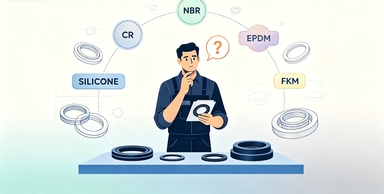
Explore common rubber types and learn how to select the perfect rubber for your application with Maihua Rubber.
2026/07/15
Discover common rubber part failures like cracks and leaks. Learn their causes and effective solutions from Maihua Rubber.