EN
EN

How to Install & Maintain Rubber Seals & Gaskets: Avoid Early Failure & Extend Lifespan
2026/07/15
Learn how to install and maintain rubber seals and gaskets to avoid failure and extend their lifespan.
Many design engineers and procurement teams underestimate how much material selection impacts rubber component service life. It is very common to see seals crack, swell, harden or leak prematurely simply because the elastomer grade does not match operating conditions.
If you are trying to figure out how to choose rubber material for your upcoming project, this practical guide breaks down widely used industrial rubber variants, their real-world strengths and weaknesses, and clear matching scenarios to help you avoid costly trial-and-error.
All elastic rubber materials fall into two broad groups: natural rubber and synthetic rubber. Getting clear on their core differences creates a solid starting point for material screening.
Harvested from rubber tree latex, natural rubber delivers exceptional resilience, high tensile strength and reliable tear resistance. It also performs well for vibration damping requirements.
Strengths: Outstanding elasticity, good abrasion performance, easy bonding with metal inserts, cost competitive for general flexible components
Limitations: Poor resistance against mineral oils, fuels, ozone and UV radiation. Parts will age rapidly under continuous outdoor exposure
Typical uses: Shock mounts, vibration isolation pads, rubber rollers, flexible buffers and non-oil contact elastic accessories
For buyers searching which rubber is oil resistant, NBR remains the most cost-effective standard solution across global machinery sectors.
Strengths: Strong tolerance to mineral oil, lubricants, hydraulic fluid and gasoline; balanced mechanical properties at moderate temperatures
Limitations: Not built for long-term outdoor installation; ozone and UV stability are weak; operating temperature range has clear upper limits.
Typical uses: Oil seals, fuel gaskets, hydraulic o-rings, automotive rubber fittings, machinery seals exposed to lubricants.
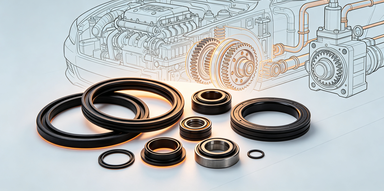
When projects require materials for long-term outdoor installation, most engineers turn to EPDM. This is why many users search for the best rubber for outdoor use, rubber for steam and hot water.
Strengths: Excellent resistance to ozone, sunlight and weather aging; stable performance in hot water and saturated steam; retains flexibility at low temperatures
Limitations: Must never be deployed alongside petroleum oil, grease or hydrocarbon fuels. Severe swelling and failure will occur
Typical uses: Outdoor sealing strips, plumbing gaskets, cooling system hoses, solar and construction rubber profiles, components contacting drinking water.
Silicone stands out thanks to stable performance across extreme temperature ranges, together with hygienic characteristics. Many customers look for silicone rubber for high temperature and food contact.
Strengths: Working range roughly -60°C to 220°C; odor-free, non-toxic formula options available; reliable weather resistance and electrical insulation
Limitations: Limited resistance to oils and many solvents; relatively low tear strength under continuous dynamic friction
Typical uses: Food processing equipment seals, medical rubber components, oven door gaskets, electrical insulation parts
FKM is a premium elastomer developed for harsh operating environments. Users researching chemical resistant rubber for extreme environment will frequently encounter this material.
Strengths: Top-tier resistance to high heat, fuels, concentrated chemicals, acids and solvents; low compression set under sustained pressure
Limitations: Significantly higher raw material cost; flexibility drops sharply at sub-zero temperatures
Typical uses: Automotive engine sealing, chemical equipment gaskets, fuel system hardware, industrial equipment exposed to aggressive media.
Strengths: Balanced performance against weather exposure, ozone, mild oil and flame spread; solid physical toughness.
Limitations: Medium oil resistance only; unsuitable for environments with strong solvents.
Typical uses: Cable outer jackets, general outdoor cushions, anti-vibration pads, waterproof sleeves.
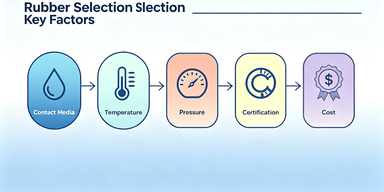
After learning different rubber types, check these critical conditions to narrow down your options:
1. Contact Media: Will the rubber part come into contact with oil, fuel, water, steam, acid, alkali, solvent or chemical media? The material must resist the specific medium it meets in service.
2. Temperature: Consider both continuous operating temperature and occasional peak temperature. A rubber that works at room temperature may fail rapidly under sustained high heat.
3. Pressure: Seals, gaskets and rubber components under high pressure need proper hardness, compression set resistance and structural design.
4. Certification: Applications involving food contact, drinking water, medical parts or electrical equipment may require FDA, REACH, RoHS or other local compliance standards.
5. Cost: Balance initial material cost with expected service life. A cheaper rubber grade may become more expensive if it fails too quickly.
Many rubber failures are not caused by manufacturing defects, but by poor material selection.
· Using EPDM in an oil environment can cause severe swelling and leakage.
· Using NBR for long-term outdoor installation may lead to surface cracking after several months.
· Using silicone rubber for heavy dynamic abrasion can result in quick tearing under repeated friction.
· Using natural rubber in contact with fuels or oils will generally lead to softening, swelling or degradation.
2026/07/15
Learn how to install and maintain rubber seals and gaskets to avoid failure and extend their lifespan.
2026/07/15
Discover common rubber part failures like cracks and leaks. Learn their causes and effective solutions from Maihua Rubber.